
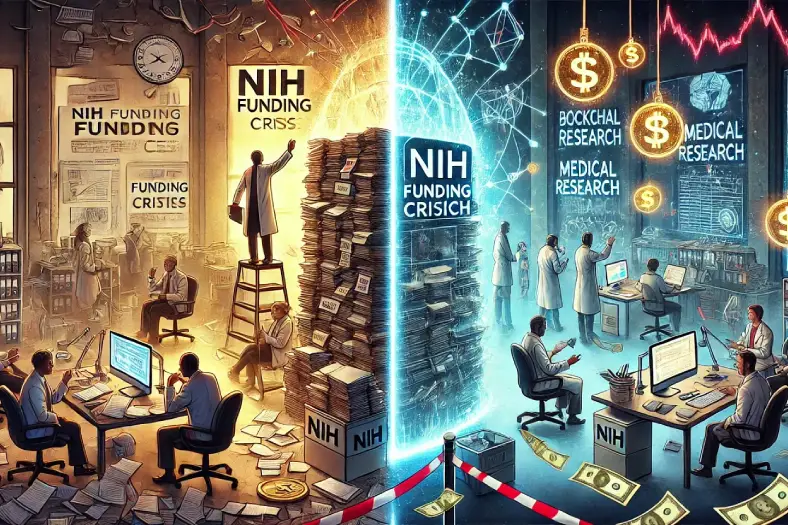
The recent proposals to cut university grant funding, particularly from the National Institutes of Health (NIH), represent more than just a budgetary decision—they signify a critical moment that demands we reimagine how scientific research is funded and conducted. While traditional funding mechanisms have served us well in many ways, they’ve also created a system laden with bureaucratic inefficiencies, endless grant writing cycles, and limitations that often stifle innovation.
Enter Decentralized Science (DeSci), a revolutionary approach that leverages blockchain technology and decentralized autonomous organizations (DAOs) to democratize research funding and execution. As someone who has navigated both traditional academic research and innovative healthcare solutions, I see DeSci as not just an alternative but a necessary evolution in scientific research.
The Failures of Traditional Science Governance
For decades, scientific research has been controlled by a handful of powerful institutions—governments, corporate interests, and academic publishing giants. These entities dictate:
- Who gets funded (favoring established names over new ideas),
- What gets published (gatekeeping breakthrough discoveries), and
- Who benefits (patents often benefit institutions, not individual researchers).
Even more troubling, scientific funding is increasingly vulnerable to political shifts. Executive orders have restricted federal funding for certain areas of research, tightened immigration policies for international scientists, and even suppressed findings that conflicted with political agendas.
Meanwhile, corporate interests prioritize research that maximizes profits over that which serves the greater good. Life-saving drugs are kept behind paywalls, AI research is hoarded by tech giants, and groundbreaking studies often disappear into proprietary databases.
We Need a New Model—One That is Open, Decentralized, and Unstoppable.

How DeSci Can Work: The Blockchain-Powered Science Revolution
DeSci leverages blockchain technology and decentralized autonomous organizations (DAOs) to create a more open, transparent, and efficient research ecosystem. Here’s how it can address the shortcomings of traditional funding models:
1. Open & Crowdfunded Research
DeSci platforms allow anyone to contribute to research projects they find valuable. This crowdfunding approach can provide opportunities for innovative projects that might be overlooked by traditional grant committees. Instead of waiting for government grants, researchers can secure funding directly from the global community. Blockchain-based DAOs (Decentralized Autonomous Organizations) like VitaDAO and LabDAO enable scientists to propose projects and receive funding from investors, philanthropists, and even the general public through tokenized contributions.
🧪 Example: A cancer researcher who is denied NIH funding due to bureaucratic red tape can raise funds through a decentralized DeSci platform, issuing Science NFTs (S-NFTs) that represent intellectual ownership of findings.
2. Decentralized Peer Review
The current academic publishing system is controlled by a few elite journals (like Nature and Science), which often reject groundbreaking research due to institutional bias or political sensitivity. DeSci replaces this with a transparent, blockchain-based peer review system, where:
- Independent experts review research openly.
- Reviews are stored permanently on-chain, preventing censorship.
- Reputation scores for reviewers ensure credibility and prevent fraud.
🔬 Example: Instead of waiting years to publish a breakthrough AI-driven drug discovery, researchers can instantly publish on a blockchain-based journal, where peers validate the findings without bias.
3. Tokenized Intellectual Property & Open Science
Currently, big pharma and biotech companies lock research behind patents and paywalls. DeSci tokenizes intellectual property through IP-NFTs (Intellectual Property Non-Fungible Tokens), allowing researchers to:
- Own and license their discoveries without corporate intervention.
- Receive direct royalties whenever their work is used in commercial applications.
- Keep scientific knowledge open, ensuring equitable access to lifesaving innovations.
⚕️ Example: Instead of a single corporation owning a gene therapy patent, a community of scientists and patients can co-own the research via blockchain-based fractional ownership.
Call to Action
The time has come for researchers, institutions, and funding bodies to embrace DeSci as a complementary system to traditional research funding. Here’s how you can get involved:
- Explore existing DeSci platforms and DAOs
- Participate in governance discussions
- Consider launching research projects through DeSci mechanisms
- Advocate for institutional support of DeSci initiatives
The Future: Breaking Free from Federal Funding
As we face potential cuts to traditional research funding, it’s crucial that we explore alternative models. DeSci offers a promising path forward, one that could make research more efficient, transparent, and accessible.
By shifting power from governments and corporations to decentralized communities, DeSci creates an ecosystem where scientific progress is unstoppable. Researchers are no longer beholden to bureaucrats, discoveries are no longer locked behind paywalls, and knowledge is no longer held hostage by the elite.
The question is no longer if DeSci will disrupt the scientific establishment—but when. The sooner we embrace decentralized research, the sooner we can unlock discoveries that will change the world.
To my fellow researchers and innovators, I say this: Don’t wait for change to come from the top. Embrace the principles of DeSci in your work. Explore decentralized funding options, advocate for open access, and participate in decentralized peer review processes.
To policymakers, I urge you to consider the potential of DeSci as you shape the future of research funding. Rather than simply cutting budgets, let’s invest in innovative models that could revolutionize how we do science.
The future of scientific research doesn’t have to be constrained by bureaucratic chains or limited by shrinking budgets. With DeSci, we have the opportunity to create a more open, efficient, and innovative scientific ecosystem. Let’s seize this opportunity and usher in a new era of discovery and progress. The future of scientific research depends on our willingness to innovate not just in our laboratories, but in how we fund and conduct research itself.

0 Comments